Scientific studies have demonstrated that numerous declines and diebacks affecting horticultural crops, forests and natural ecosystems in Europe, Australia and the Americas are primarily caused by invasive soil- or airborne pathogens from the genus Phytophthora. Extensive surveys conducted in more than 2,500 nurseries and a similar number of restoration and planting sites across Europe revealed near-ubiquitous infestation with over 120 Phytophthora species, most of them exotic.
Nursery accreditation schemes have been operating successfully for years in Australia, California and recently the United Kingdom. They showcase that the spread of invasive plant pathogens can be drastically reduced through effective biosecurity standards, improving plant quality while ensuring the economic viability of the nursery sector.
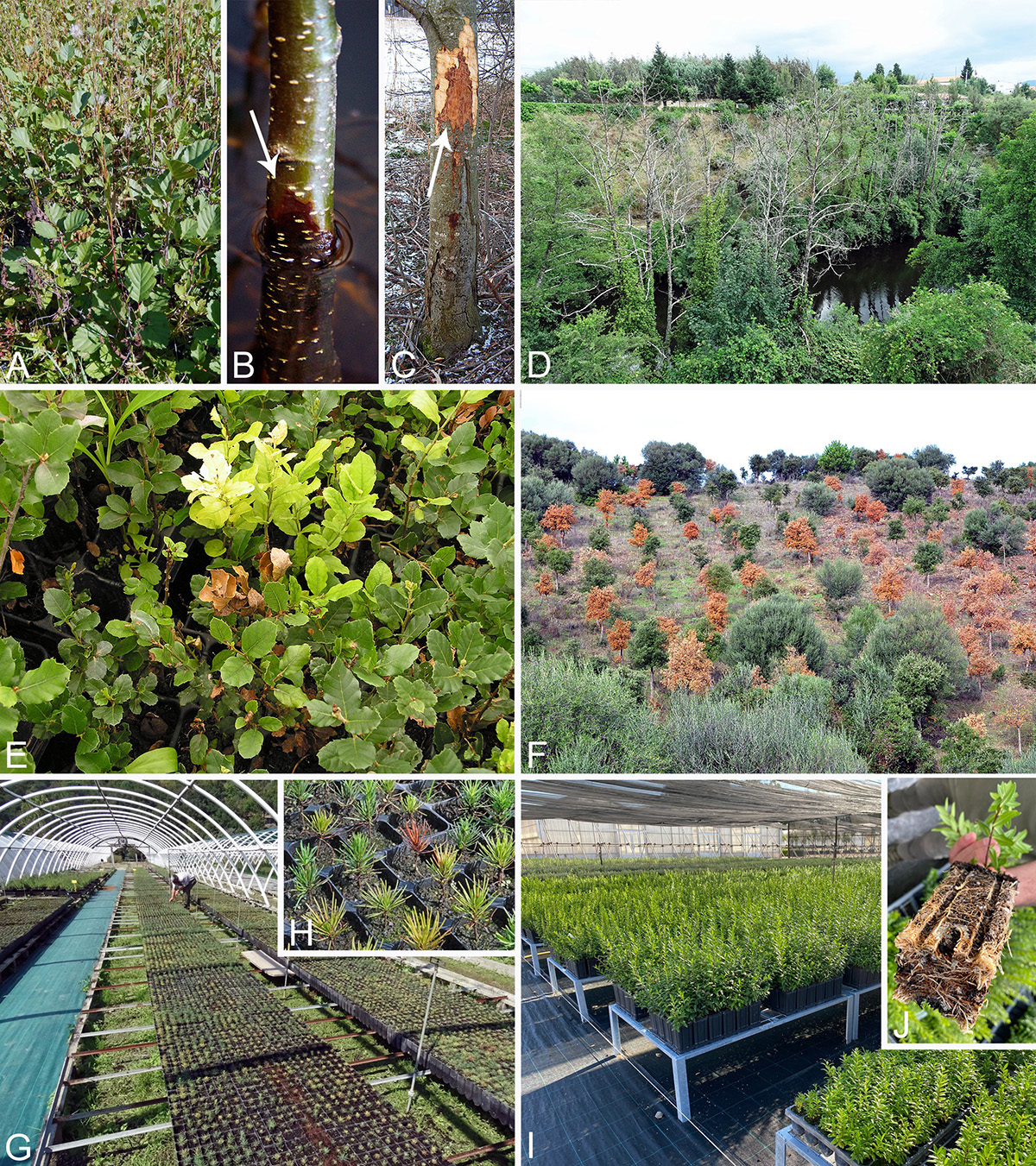
The pathway of invasive Phytophthora pathogens from nurseries via planting activities to natural forests and best nursery management practices. A–D. The root and collar rot epidemic of alder (Alnus spp.) trees across Europe.
A. Healthy-looking Alnus glutinosa seedlings in a nursery.
B. Development of a black collar rot (arrow) caused by Phytophthora ×alni in a healthy-looking A. glutinosa nursery plant with a previously suppressed infection after 1 week of flooding.
C. Advancing bark canker (arrow) in a planted A. glutinosa tree caused by P. ×alni.
D. Extensive mortality of a riparian A. glutinosa forest caused by P. ×alni.
E–F. Cork oak (Quercus suber) decline in Southern Europe.
E. Container stand on the ground of a nursery with several cork oak plants showing chlorosis or mortality due to root rot caused by Phytophthora cinnamomi.
F. Cork oak afforestation with high mortality due to root rot caused by P. cinnamomi.
G–H. Pine seedlings in containers close to the ground with chlorosis and mortality due to irrigation with untreated river water infested with several Phytophthora species.
I–J. Healthy Myrtus communis seedlings with healthy root systems in containers on tables lifted >80 cm from the ground and irrigated with pathogen-free filtered water.
PurPest Webinar Code of Conduct
PurPest webinars are intended to provide a professional, respectful, inclusive, and harassment-free environment for all participants.
By joining this event, participants agree to:
- engage respectfully and professionally with others;
- refrain from exploiting participation in the event for communication of political statements, views or opinions or using any discriminatory, offensive, or disruptive behaviour or language
- contribute to a constructive atmosphere for discussion and exchange.
Any inappropriate conduct may be reported to the organisers. The PurPest project reserves the right to remove any participant whose behaviour is considered inappropriate. Decisions of the organisers in such cases are final.