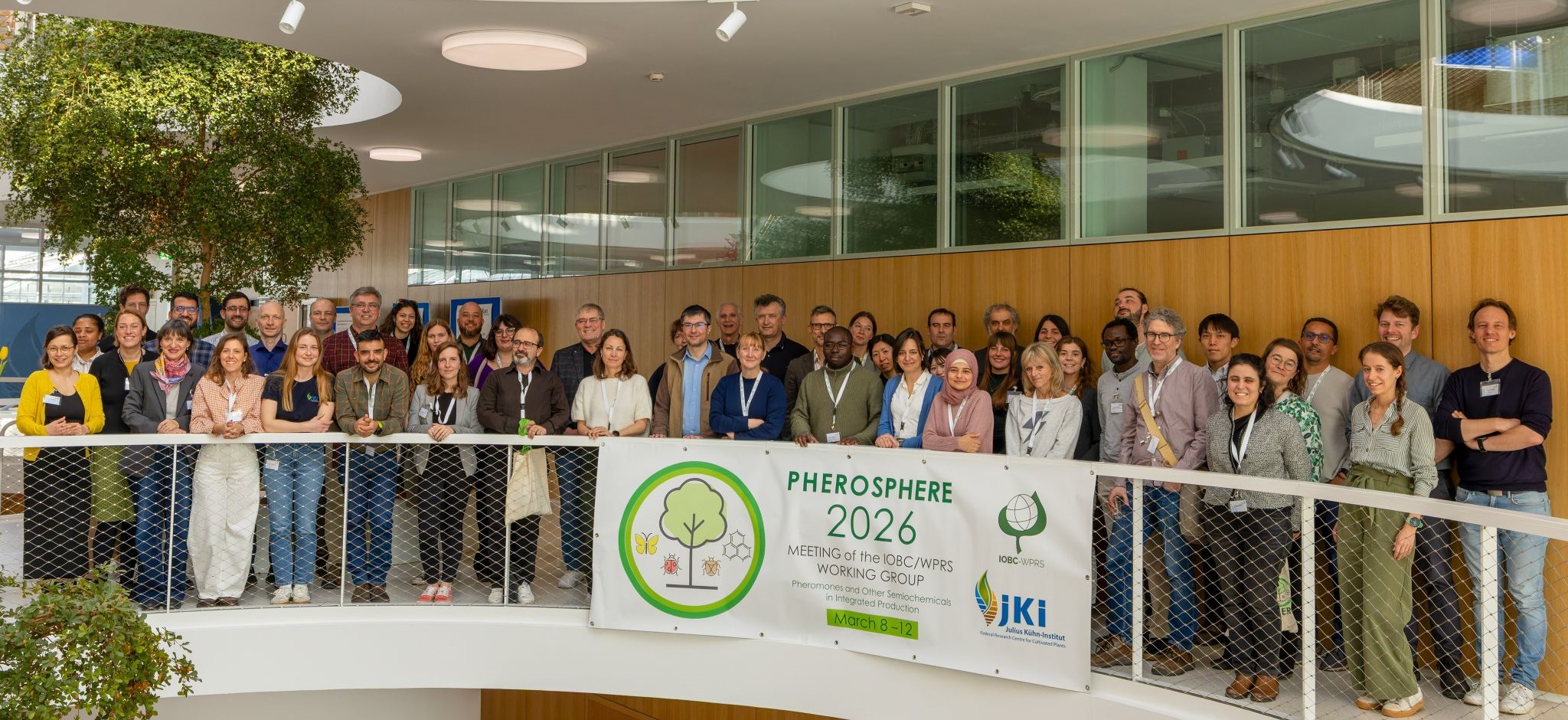
A dedicated session entitled "Pest Volatile Fingerprints for Early Detection and Monitoring" highlighted several research activities carried out within the PurPest project and by project collaborators. The session featured five presentations exploring the use of VOCs and sensing technologies for the early detection of plant pests and pathogens:
Ali Karimi (Julius Kühn-Institut, Germany) presented "Dual biotic stressors shape volatile organic compound emission patterns in pome fruit trees", examining how simultaneous pest and pathogen attacks influence VOC emissions in apple and pear trees. Óscar González López (Universidad de La Rioja, Spain), who completed a sabbatical stay at JKI as part of PurPest, presented "Potential of Volatile Organic Compounds as Early Indicators of Biotic Stress in Malus domestica", focusing on VOC signatures associated with 'Candidatus Phytoplasma mali' and woolly apple aphid infestations. Amandine André (University of Neuchâtel, Switzerland) presented "Application of odor-sensing devices for early pest detection", showcasing advances in sensor technologies for non-destructive detection of plant pests. Charles Kwadha (Norwegian Institute of Bioeconomy Research – NIBIO, Norway) presented "The smell of Phytophthora: Characterization of Phytophthora-infected Rhododendron and Larix plants", investigating VOC profiles associated with Phytophthora infections. Marta Bosque Fajardo (NIBIO, Norway) presented "Do we find pest specific volatile cues which can reliably detect the Cotton Bollworm, independent of host plant species and independent of environmental stress?", exploring robust VOC markers for the early detection of Helicoverpa armigera.
Together, these contributions demonstrated the breadth of PurPest's research on volatile organic compounds, sensor technologies, and early pest detection, while fostering collaboration between project partners and the wider scientific community working on innovative and sustainable plant health solutions.